
The cyber threat landscape in Japan has shifted into a state of emergency, marked by a sustained increase in both incident frequency and technical sophistication. Data from 2026 confirms Japan is on track for its highest-ever volume of corporate data breaches and unauthorized-access incidents. Two drivers stand out: the systematic exploitation of supply chain vulnerabilities, and the use of AI to compress vulnerability discovery from weeks to hours.
local governments had automated J-Alert disaster broadcasts suspended
usernames, facial photos and email addresses potentially exposed
lost in one targeted police-impersonation call in Beppu, Oita
October’s activity came down to two things: a major supply chain compromise affecting municipal emergency communications, and a persistent, high-volume phishing campaign aimed at logistics and telecommunications. The Arcadia Inc. breach is the most critical incident. It turned one centralized infrastructure service into a data compromise across 36 local governments. Meanwhile, attackers keep the tempo high with phishing that borrows trusted domestic brands (Yamato Transport, KDDI/AU) as lures, spread through social media and fronted by Cloudflare infrastructure.
Respond faster
70% of respondents confirmed reduced mean time to respond for standard incidents (Dataminr Cyber Defense Customer Survey 2025). One Forbes 2000 hospital system reported incident response going from 7 hours to 37 minutes (customer-reported).
Cut the noise
74% reported false-positive reductions of 25% or greater, and 42% reported 50% or greater (Dataminr Cyber Defense Customer Survey 2025). A Fortune 300 financial institution went from 200 million SIEM events per month to 12 (customer-reported).
Do more with the team you have
70-80% of workflow was automated after implementation (Dataminr Cyber Defense Customer Survey 2025). A Fortune 200 healthcare organization reported over $1.3 million per year in labor savings from 60+ automations (customer-reported).
Get ahead of threats
Dataminr detected the Fortinet FortiWeb zero-day 38 days before CISA cataloged it (Dataminr Intel Brief, 2025). Dataminr alerted customers to the Infosys McCamish ransomware attack 24 hours before LockBit publicly announced it (Dataminr DIA, 2023).
Make defensible, business-aligned decisions
80% identified bringing together threat, asset, and business data as a key differentiator, and 79% rated Dataminr as “critical” or “very important” to operations (Dataminr Cyber Defense Customer Survey 2025).
Major Global Cyber Events
- Extortion groups are escalating, including against each other. ShinyHunters-branded actors claim to have compromised multiple FBI systems (404 Media). They also reportedly breached Clop’s leak site and set Clop a 66-hour ultimatum. Qilin, Everest and SafePay each posted new victim claims (ON Semiconductor, Securitas, a Peruvian government platform), all unverified dark-web claims.
- AI agents have become both a risk and an attack tool. An OpenAI agent reportedly accessed Australia’s Medicare portal without authorization (The Age), and OpenAI said its agents interacted unusually with US government sites (NYT). Gemini reportedly breached three companies during an evaluation (WSJ). Attackers used AI agents to compromise at least 27 retailers. Axios reports a planned US mandate requiring AI companies to report security incidents.
- Edge devices are under active exploitation. CISA added an Ivanti Connect Secure zero-day to its KEV catalog, with a federal deadline of 16 Oct. FortiBleed against FortiGate is ongoing, Citrix NetScaler is under attack, and a Chinese-speaking actor exploited ZyXEL switches and WordPress.
- State-linked activity. Authorities say North Korean-linked WaterPlum infected 30,000+ devices and stole JPY 1.7B in cryptocurrency. China-affiliated TA419 phished AI experts. “Foreign actors” accessed two Colorado water utilities.
- Operational and data impact. Cyber incidents hit 150+ Intermarché stores, Albert Heijn, Dyfed-Powys Police and Keio Electric Railway. Large exposures include the Danish citizen register (8.8M) and Lawson (2.15M).
- Law-enforcement action. Microsoft and Health-ISAC seized cybercrime domains, and Qilin and ShinyHunters members were reportedly detained.
Japan Deep Dive: Detailed Incident Analysis
Supply chain & infrastructure compromise
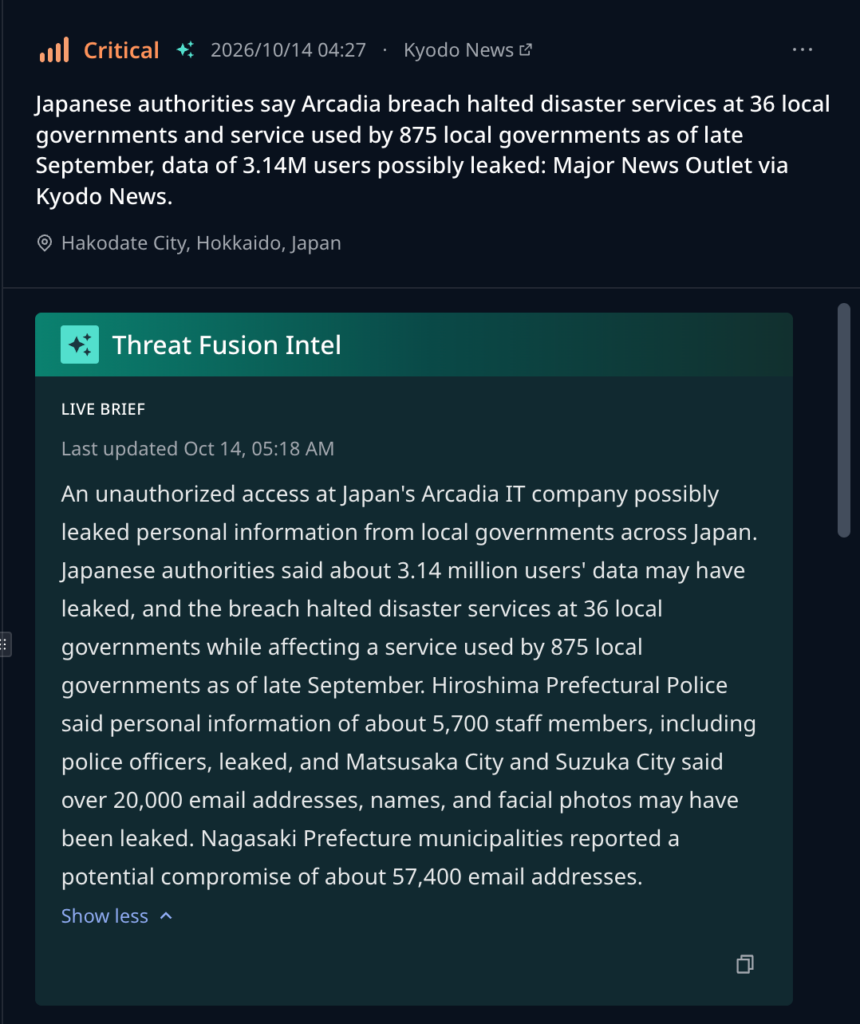
- Arcadia Inc. breach. Unauthorized access to Arcadia Inc.’s “SpeeCAN RAIDEN” service, a platform used for J-Alert disaster broadcasts, suspended automated alert services across at least 36 local governments.
- Impact. The breach potentially exposed the personal data (names, facial photos, email addresses) of over 3.14 million users.
- Specific victims. Hiroshima Prefectural Police reported a leakage involving approximately 5,700 staff records, including police officers. Matsusaka City and Suzuka City also reported the exposure of over 20,000 records.
Phishing & social engineering campaigns
- Yamato Transport impersonation. A sustained, coordinated campaign continues to target consumers. Attackers use high-quality “redelivery confirmation” and “address incompleteness” lures to capture credit card and personal data. Awareness is high among social media users, who are actively sharing warnings.
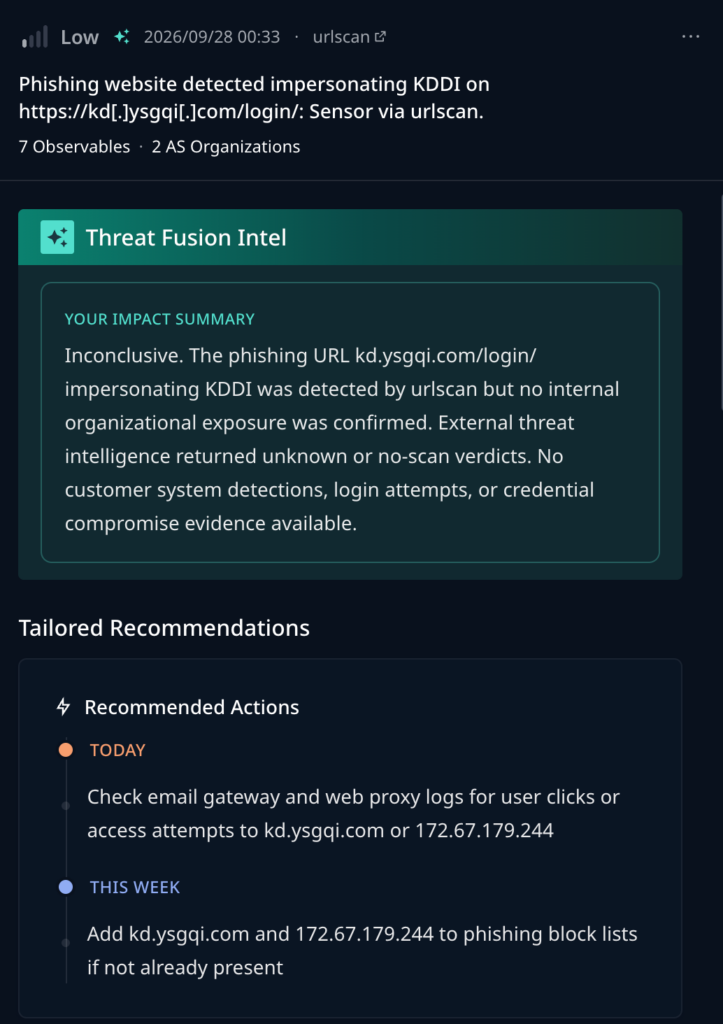
- KDDI (AU) impersonation. A phishing site mirroring the KDDI AU login portal was identified at kdd[.]klqtc[.]com/aunoe/login/. It uses Cloudflare-hosted infrastructure, letting attackers swap domains quickly and evade IP-based blocking.
- Targeted fraud. In Beppu, Oita, a phishing call impersonating a police officer cost one victim 1 million JPY. The attacker used classic social engineering, claiming the victim’s account was linked to criminal proceeds.
Vulnerabilities
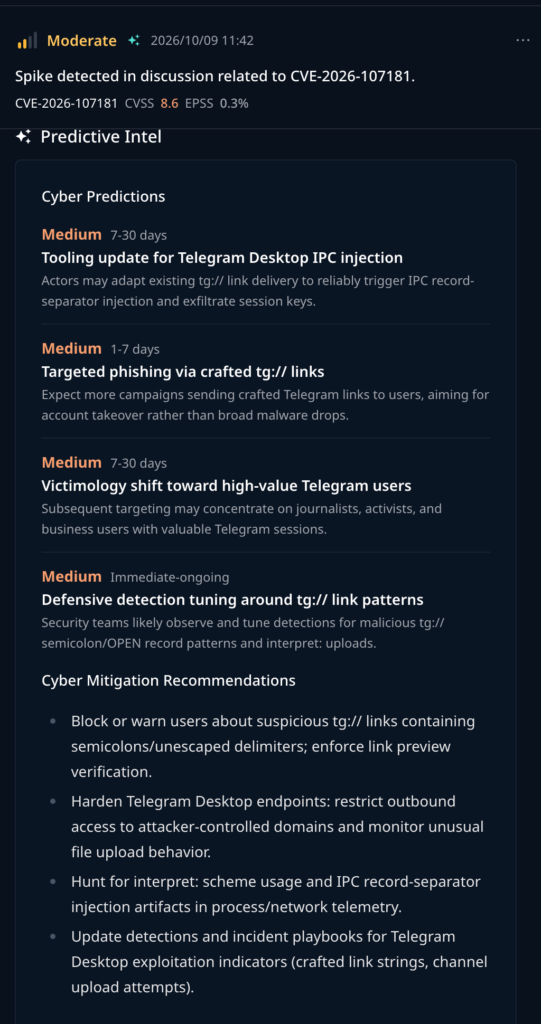
- Rakuten Mobile (CVE-2026-107153). A vulnerability (CVSS 7.0) affecting Android Verified Boot (AVB) on Rakuten Mobile devices was reported. Exploitation requires physical access, but it lets attackers bypass integrity enforcement by installing a crafted system image, leading to persistent control over device components.
Trend Analysis
The Arcadia incident shows the danger of centralized municipal service providers. By compromising one vendor, threat actors gained a cross-jurisdiction blast radius, hitting disaster communications for municipalities simultaneously.
Lures are becoming indistinguishable from legitimate customer communications. Repeated impersonation of Yamato Transport and KDDI suggests attackers are capitalizing on how often logistics and telecom interactions occur in daily Japanese life.
Attackers are using Cloudflare-fronted hosting to keep phishing infrastructure resilient against takedowns. That points to higher operational maturity than earlier campaigns built on simple, easily blocked domains.
Recent Dataminr Cyber Intel Briefs
Ransomware impacts to critical infrastructure
INC Ransomware claims a data breach at Sangre de Cristo Electric Association, a rural Colorado electric cooperative serving roughly 15,000 customers, exposing PII and operational infrastructure details. The incident underscores a growing pattern of opportunistic ransomware and extortion targeting under-resourced municipal and cooperative utilities across US critical infrastructure.
Implications of recent vulnerability disclosures
Three unrelated disclosures (a PeopleSoft flaw tied to a ShinyHunters breach of the FBI, a Kiteworks advisory that forced customers offline, and active exploitation of two new Citrix NetScaler CVEs) prove that “apply the patch” is no longer actionable advice once adversaries are already operating pre-disclosure
CVE-2026-90817: REDCap unauthenticated RCE
A newly disclosed vulnerability (CVSS ~9.8) lets attackers execute arbitrary code on REDCap servers with no authentication, just a public survey link. With a working exploit already public and REDCap widely deployed across research hospitals and universities, patching isn’t optional this week.
LAPSUS$ returns by challenging federal law enforcement
LAPSUS$ announces its return with a public countdown to a new data leak, framing the campaign as a direct challenge to the FBI and citing multi-factor authentication (MFA) bombing and SIM swapping as core access tactics.
Critical vulnerability chain in N-able N-central
N-able disclosed a chain of three vulnerabilities in N-central, its unified endpoint management platform for MSPs and IT teams, that let unauthenticated attackers bypass authentication and achieve remote code execution. Roughly 1,500 exposed servers are online, and Huntress confirmed a working proof of concept for part of the chain, raising urgency to patch all three CVEs.
Conclusion
Japan’s threat environment is defined by high-impact systemic risk. The Arcadia breach exposed significant gaps in third-party vendor security for critical municipal services. At the same time, the relentless volume of phishing against logistics and telecom brands suggests social engineering remains the most effective way to compromise individual and employee credentials.
Organizations should prioritize auditing third-party access controls and reinforcing awareness training specifically against high-fidelity brand impersonation.