


Key Takeaways
- Chain of three CVEs: N-able disclosed a chain of three vulnerabilities in N-central, its unified endpoint management platform for MSPs and IT teams, that together allow an unauthenticated attacker to bypass authentication, gain full platform access, and achieve remote code execution.
- Exploit PoC: A weaponized exploit for CVE-2026-86218 (CVSS 10.0) was published publicly on September 6, 2026, and the vulnerability was added to known-exploited vulnerability catalogs the same day. Huntress separately reported it had produced a proof of concept for the CVE-2026-86206/CVE-2026-86207 chain.
- Large Target Set: Reports point to roughly 1,500 N-central servers exposed online, giving attackers a large, externally reachable target set. The combination of public PoCs and weaponized code is consistent with rapid, automated exploitation attempts against exposed instances.
- Multi-Step Remediation: Full remediation requires more than one patch: fixes are split across N-central 2026.3 HF3 (build 2026.3.1.13) and 2026.3.1.14, with CVE-2026-86207 also requiring 2026.4. Organizations should confirm all three are addressed rather than patching to the version tied to only one CVE.
Incident Overview
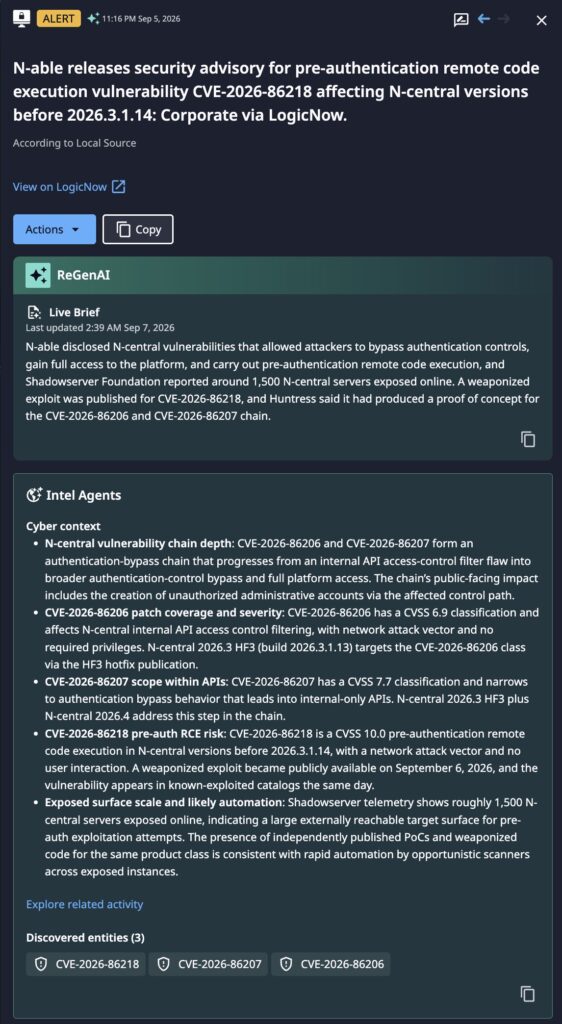
N-able disclosed a set of N-central vulnerabilities that, chained together, let attackers bypass authentication controls, gain full access to the platform, and carry out pre-authentication remote code execution. Shadowserver Foundation identified approximately 1,500 N-central servers exposed to the internet.
An exploit for the most severe flaw in the chain, CVE-2026-86218, was published on September 6, 2026, and the vulnerability was added to known-exploited catalogs that same day. Huntress reported it had independently produced a proof of concept for the CVE-2026-86206 and CVE-2026-86207 portion of the chain.
Dataminr Alert
Technical Details
The chain begins with CVE-2026-86206 (CVSS 6.9), a flaw in N-central’s internal API access control filtering that is exploitable over the network with no privileges required. This leads into CVE-2026-86207 (CVSS 7.7), which narrows to an authentication bypass allowing access to internal-only APIs. Together, the two flaws let an attacker escalate from the API filtering weakness to broader authentication bypass and full platform access, including the ability to create unauthorized administrative accounts through the affected control path.
The chain culminates in CVE-2026-86218 (CVSS 10.0), a pre-authentication remote code execution vulnerability affecting N-central versions prior to 2026.3.1.14, exploitable over the network with no user interaction required. N-able has addressed CVE-2026-86206 in N-central 2026.3 HF3 (build 2026.3.1.13), CVE-2026-86207 in 2026.3 HF3 and 2026.4, and CVE-2026-86218 in 2026.3.1.14. Organizations need to apply the full set of fixes rather than a single update to close the entire chain.
Note that the relatively low CVSS scores for CVE-2026-86206 and -86207 (6.9 and 7.7, respectively) may result in these being overlooked when triaging emergency patching actions, but that these items must be addressed to mitigate against the full exploit chain.
Threat Actor/Motivation
No threat actor has been publicly attributed to exploitation of this vulnerability chain at this time.
Immediate Actions/Recommendations
- Patch fully: Upgrade N-central to a version that addresses all three CVEs, at minimum 2026.3.1.14 with HF3 applied, or 2026.4 where required for CVE-2026-86207. Confirm patch levels rather than assuming a single update resolves the full chain.
- Prioritize based on exposure: Treat any internet-facing N-central instance as high priority given the ~1,500 exposed servers identified by Shadowserver and the availability of both PoC and weaponized exploit code.
- Restrict exposure: Confirm N-central management interfaces and APIs are not directly reachable from the internet. Where remote access is required, place them behind a VPN or equivalent access control layer.
- Audit for compromise: Review N-central logs for unauthorized administrative account creation, unexpected API access patterns, or command execution predating the patch, particularly on instances that were internet-facing before remediation.
- MSP-specific review: Because N-central manages downstream client endpoints, MSPs should treat any suspected compromise as a potential supply chain event and assess whether managed client environments require independent review.
- Track exploitation activity: Monitor N-able advisories and known-exploited vulnerability catalogs for updates, given that weaponized code for CVE-2026-86218 is already public.

2026 Mid-Year Threat Landscape Report
The first half of 2026 was defined by a widening gap between attack speed and defense speed — and AI is accelerating both sides. Dataminr’s 2026 Cyber Threat Landscape Mid-Year Report pulls from 4,500 threat actors tracked, 73,000 vulnerabilities detected, and over 2 million alerts processed per month to surface what actually mattered in H1 and what teams need to prepare for in H2.
Download Report