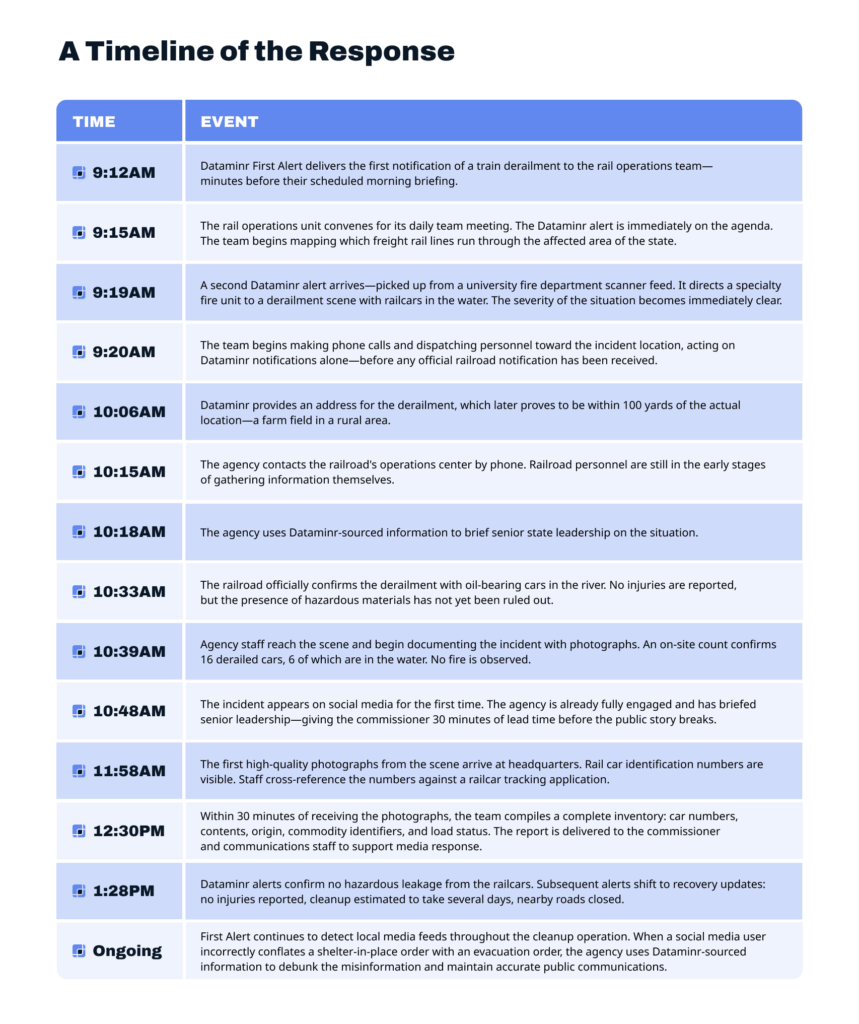
At 9:12 a.m., a state agency received a report of a train derailment in a rural area. Seven minutes later, the team received a second alert from a university fire department scanner feed directing a specialty fire unit to a derailment scene with train cars in the water. By 9:20, the state rail operations team began dispatching personnel to the scene — before any official notification from the railroad.
When the story broke on social media at 10:48 a.m., the agency had personnel on-site and had briefed senior leadership who were prepared for the news to go public.
By 12:30, the agency had received high-quality photos from the scene, traced the railcar identification numbers to figure out what each car contained, and delivered the information to the commissioner and communications staff. About an hour later, First Alert confirmed there were no hazardous leaks and the scene shifted to recovery updates.
In the chaos of an emergency like a derailment, operations teams might not have an opportunity to immediately notify the state agency. However, the earlier the state team is notified, the more quickly and effectively it can respond. Dataminr First Alert helps fill the communications gap, ensuring that the state agency can act quickly and decisively, while the operations team remains focused on safety and emergency response.
Transportation and transit authorities have the challenging job of ensuring complex critical infrastructure operates safely and efficiently. Dataminr helps these teams maintain visibility into the physical and digital environments, ensuring transportation teams can prioritize operations and responses.
Gain Real-Time Updates and Situational Awareness
Transportation authorities are responsible for maintaining, planning, operating, and securing a broad range of rail systems, highway infrastructure, buses, roads, ferries, tunnels, paratransit, and other areas. Given the complexity of these transportation networks, the range of potential incidents is vast. It’s critical that these teams have up-to-the-minute information and visibility into everything that’s happening whether it’s a cyberattack disrupting traffic lights or a communications outage impacting a ferry.
First Alert helps discover critical issues first, offering information and ensuring teams have real-time data to respond effectively. The platform can identify potential issues of all sizes, from a piece of debris on a main highway to a multi-car accident in a remote town.
Beyond the initial event, the interdependency of transit systems often leads to cascading impacts in other areas. For example, an out-of-service train increases the number of passengers on a ferry or a car accident diverts traffic through a small downtown area. Dataminr helps eliminate blind spots and minimize disruptions to other passengers or systems by providing situational awareness of broader impacts. Further, using Agentic AI, the platform provides instant context and answers the “so what” of events as they unfold, so teams have all up-to-date information to make better decisions.
Create a Common Operating Picture
Transit incidents or threats often spill into the jurisdiction of multiple agencies, which means communication between these groups is essential. For example, a flooded street requires emergency services and utility workers. However, siloed systems where alerts must be shared manually via phone or email, workflows that don’t loop in partner agencies, and groups with limited or no process for interagency communications create additional delays and confusion. These systems are not designed to purposefully gatekeep information, but won’t prioritize communications over ensuring the safety of people or physical assets.
Dataminr can create a common operating picture that delivers relevant real-time updates and alerts to every group and agency. Agentic AI does the work of surfacing what’s changed and why it matters, so everyone involved can be looking at the same photos of that flooded street and making decisions based on the most recent data. This reduces the time required to manually disseminate information, ensuring people receive the information that is relevant to their role and via their preferred channel.
Major Event Preparation and Management
The 2026 FIFA World Cup games were an exercise in planning and coordination for transit authorities. With expected attendance rates of 6 million people for the 78 matches held in the U.S., the logistics of ensuring the safety and mobility of fans, players, emergency services, officials, and all other parties required multi-year strategic planning. It included extra bus services, trains, additional security checkpoints, station planning, and simultaneous coverage across host cities. Security teams had to be prepared for any “what-ifs”: cyberattacks targeting the ticketing infrastructure or transit signage, bomb threats to railway or bus stations, or unpredictable fan behavior.
Dataminr can help detect the earliest signals of public safety incidents, which enables proactive responses to incidents like rowdy fans or overcrowding on a train platform. The platform provides actionable, early warnings to help authorities mitigate risks during the chaos of large public events.
Establish Proactive Communication with Leadership
When an event like a bus crash or trail derailment breaks on social media before relevant authorities are aware, it can create panic and confusion. Public officials and leadership need to be briefed as early as possible with as much context as possible so they can share information and updates with the public. Dataminr’s First Alert ensures security teams can provide accurate, real-time intelligence as the incident evolves, ensuring the public receives critical updates.
In today’s digital world, the risk of inaccurate information spreading is high and the impact can be very real. Dataminr helps transit authorities manage the information environment. For example, after the rural train derailment a shelter-in-place order was mistaken for an evacuation order and shared on social media. The team used First Alert to verify no evacuation was taking place, and shared the correct information.
Why Transit Agencies Must Deploy Autonomous Real-Time Intelligence
Transit and transportation agencies require accurate, real-time updates to make informed, confident decisions. Dataminr’s platform provides key information for teams, enabling them to ensure public safety and secure critical infrastructure. The platform can deliver highly relevant alerts based on role, geographic areas, topics, etc. For transit teams that require constant visibility across broad areas and transportation types, Dataminr offers early alerts and continuous updates on evolving situations. This keeps security teams’ focus where it needs to be on maintaining and securing essential systems and infrastructure.
Go back to that rural derailment: from the first scanner alert to the all-clear on hazardous materials, the state team was ahead of the story at every stage — not because they got lucky, but because they had the earliest possible signal. That’s the gap First Alert is built to close.

Orchestrating Multi-Agency Response for Infrastructure Crises
In the chaos of an infrastructure crisis, multiagency communications are critical. This on-demand webinar, featuring Jim Cook, Interim Chief of Police, Amtrak, looks at real-world incidents and practical strategies for building pre-crisis relationships, leveraging AI-driven intelligence, and shifting from reactive to proactive response postures.
WATCH NOW