As we welcome the new year, forward-thinking organizations are seizing the moment to reimagine what’s possible. The start of any year invites a fresh strategic outlook, and this is the perfect time to assess how breakthrough technologies can reshape operations, resilience, and opportunity.
Data overload is no longer just a buzzword; it is an operational reality. Security leaders, risk managers, and C-suite executives face a daily barrage of signals, alerts, and notifications. The gold standard in alerting technology has always been speed—who can tell you that a crisis is unfolding the fastest?
But speed alone is no longer enough. Knowing that something happened is only the first step. The real challenge lies in understanding what it means for your specific organization and determining the best course of action immediately.
As 2026 unfolds, the next wave of innovative technology presents a defining opportunity. We are witnessing a fundamental shift from straightforward alerting to comprehensive, AI-driven real-time intelligence. Organizations that prepare now for a future of autonomous AI agents, predictive modeling, and hyper-personalized data fusion will be poised to thrive in the years ahead.
The Shift from “What” to “So What?”
Traditionally, risk management tools focused on the “what,” simply alerting people on what the incident or risk is. While valuable, this often leaves the human analyst with a heavy cognitive load. They must manually scramble to verify the report, check other sources, and determine if the event impacts their assets.
The future of innovative technology automates this investigation. Emerging AI solutions are moving beyond simple detection to provide the “so what.”
This means technology will soon routinely deliver dynamic, evolving summaries of events. Instead of a static alert, imagine a live brief that updates itself as new information becomes available. This shift reduces the time spent on manual research, allowing teams to focus on decision-making rather than information gathering.
Want to see Dataminr in action?
The Rise of Agentic AI as a Force Multiplier
Perhaps the most exciting development on the horizon is the emergence of Agentic AI. Unlike standard generative AI, which responds to prompts, Agentic AI operates autonomously to achieve specific goals.
Think of these as digital colleagues that spring into action to begin a thorough investigation the moment a significant event is detected.
How Autonomous AI Agents Work
In a crisis scenario, an autonomous AI agent doesn’t just summarize text. It actively investigates. It can:
- Synthesize reasoning: It analyzes relevant information to construct a coherent narrative about an event.
- Gather multimodal context: It pulls data from text, images, video, and more, to build a complete picture.
- Corroborate: It checks multiple sources to verify if an event is genuinely happening, filtering out noise and misinformation.
- Highlight uncertainties: Sophisticated agents can identify what is not known, flagging gaps in intelligence that human analysts need to verify.
For organizations, this technology acts as a force multiplier. It shaves minutes or even hours off investigation times, providing a comprehensive situational report at a much faster speed than a human analyst can. This helps analysts know exactly where to look to validate information, ultimately allowing them to get to the truth faster.
Hyper-Personalization Through Data Fusion
One of the biggest limitations of current AI tools is their “one-size-fits-all” approach. A hurricane warning looks the same to a hospital administrator as it does to a supply chain logistics manager, even though the kinds of details they need to know about the event are vastly different.
Future innovative technology solves this through client-tailored intelligence. This involves fusing real-time external data (news, social signals, sensor data) with an organization’s internal data (asset locations, employee travel logs, supply routes).
The Power of Context
When AI understands your specific internal landscape, the intelligence becomes actionable immediately.
- For logistics: The system doesn’t just report a port strike; it highlights which specific shipments are delayed and suggests alternative routes.
- For physical security: It doesn’t just report a public safety incident; it overlays that event on a map of your retail locations and employee homes, so you can clearly see where it is in relation to your people and assets.
This concept of “internal-external data fusion” allows technology to reason around how an event impacts you specifically. It moves the technology from being a news ticker to a strategic consultant.
The “Now What”: Predictive Intelligence
If the current era is about real-time awareness, the next era is about predictive capability. By leveraging vast archives of historical event data, AI models are learning to predict the trajectory of unfolding events.
This is the “now what” phase of intelligence.
When an incident occurs, predictive AI will analyze thousands of similar past events to forecast potential outcomes.
- Impact trees: Systems will generate visual maps showing potential downstream effects. If a factory shuts down due to a fire, which suppliers are affected? What is the likely duration of the outage based on similar fires in that region over the last decade?
- Pattern recognition: AI can flag whether an event is typical for a region or a dangerous anomaly. For example, is a spike in cyber activity normal for this time of year, or does it match the prelude to a major ransomware attack seen three years ago?
This predictive capability allows organizations to move from reactive mitigation to proactive preparation. You aren’t just putting out fires; you are fireproofing your operations before the match is even struck.
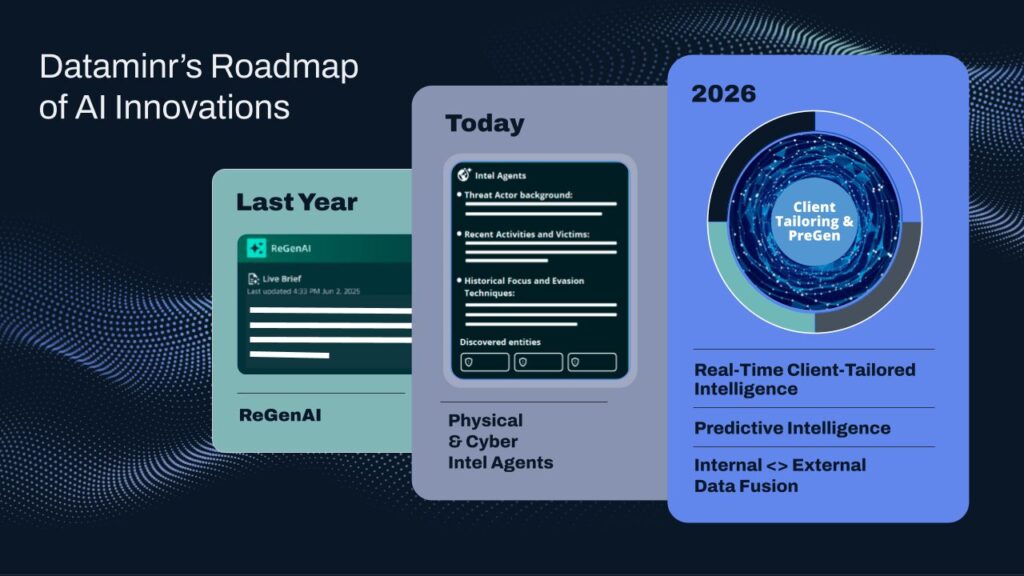
At Dataminr, our 2026 AI innovation roadmap reflects a clear commitment to redefining real-time intelligence. Details of our three key developments are to be announced later in the year. They include:
- The industry’s first Agentic AI-powered real-time client-tailored intelligence
- Predictive Intelligence
- Internal and external data fusion
Preparing Your Tech Stack for the Future
The new year offers an ideal moment to set clear intentions and invest in the groundwork for transformative technology adoption. Forward-thinking leaders should take these strategic steps to ensure their organizations are ready for the innovations gaining momentum in 2026 and beyond.
1. Audit Your Data Silos
Client-tailored intelligence requires access to your data. If your asset lists, employee rosters, and supply chain maps are locked in incompatible silos, AI cannot contextualize threats for you. Work on unifying your internal data structures.
2. Embrace Interoperability
The future is an ecosystem, not a walled garden. Look for platforms that prioritize robust APIs and developer portals. Your threat intelligence tools need to talk to your visualization software, which needs to talk to your mass notification systems.
3. Rethink Human Workflows
As AI takes over the “grunt work” of data gathering and synthesis, human roles must evolve. Analysts will spend less time on basic research and more time on high-level strategy and complex problem-solving. Start upskilling your teams to work alongside agentic AI rather than just operating software.
A fresh year invites us to dream bigger, act bolder, and prepare better. The future of innovative technology isn’t simply about faster computers or smarter chatbots; it’s about building a truly intelligent, autonomous nervous system for your organization.
By embracing agentic AI, data fusion, and predictive analytics, you transform chaos into clarity and uncertainty into opportunity. As 2026 begins, the leaders who prioritize strategic investment and future-focused thinking will not only keep pace, but set the standard for operational excellence.

Real-World Results: How Intel Agents Elevate Security Operations at Southern Glazer’s
Gain actionable insights from industry leaders at Southern Glazer’s and Dataminr in a virtual fireside exploring how Intel Agents are transforming security operations. Discover how this cutting-edge AI helps detect risks faster, respond confidently, and stay ahead of evolving threats.
Watch the Webinar