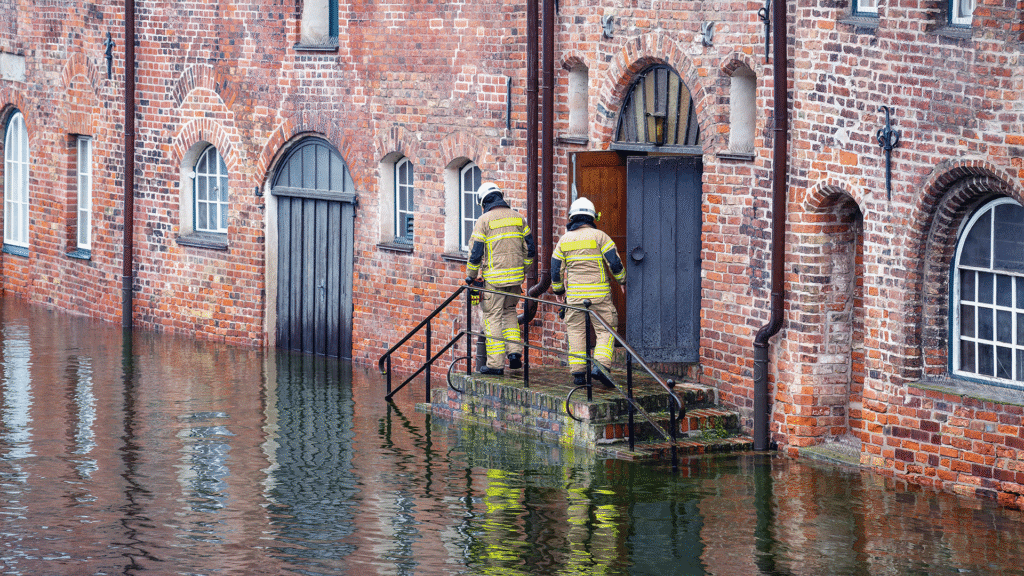
Consider a scenario that plays out in various forms across Europe every day. A major incident unfolds: a catastrophic flood, a public order crisis, or a mass casualty event. Within minutes, police, fire, and ambulance services are mobilised and the immediate threat is contained.
Then, as the first responders begin to stand down, the next stage is underway. But oftentimes, this critical second stage of emergency management is delayed. Somewhere a specialist team, local authority office, or emergency planning hub is still waiting to hear that anything happened at all.
This isn’t a failure of professionalism. It’s a structural problem built into the way emergency response is designed across much of Europe, and it has consequences that are measured in hours, resources, and lives.
Emergency Management is Consequence Management
In the EMEA region, emergency management teams are not first responders. They are the second wave—the professionals who arrive once the immediate situation is contained, and whose job is to manage everything that comes after.
That is a vast and complex responsibility. It means activating plans for temporary shelter, coordinating food and water, finding housing for displaced residents, managing hospital capacity, liaising with national health services, and notifying a chain of stakeholders that can number well into the dozens before the first hour is out. In the UK, we often refer to this as consequence management. First you manage the emergency. Then you manage the consequences.
The critical thing that’s often missed is that effective consequence management requires the earliest possible warning. Every minute’s delay in knowing that an incident has occurred is a minute lost in activating the response plan. When you’re setting up emergency accommodation, or attempting to house thousands of people displaced by floodwater, or managing the medical needs of an entire affected community, the gap between “when an incident occurs” and “when emergency management is notified” is not an administrative detail. It is a variable with real human cost.
Across Europe, that gap is routinely too wide.
A Common Problem Without a Common Picture
In the UK, the police service tends to lead coordination during major incidents—they’re the agency that’s always on scene and operating 24/7 by design. But the agencies who need to mobilise in parallel — local councils, NHS services, third-sector organisations, utility providers — often lack the same round-the-clock capability. More critically, they’re frequently working from entirely different information sources, many of which are not updated in real-time.
What this creates is information asymmetry. The people on scene know what’s happening. The people who need to activate the aftermath response and manage public communications often don’t — not until someone has had a moment to ring them, which in a fast-moving incident can be hours in. That fragmentation doesn’t simply create confusion, it actively impairs decision-making.
We saw this demonstrated during the summer 2024 major public disorder in England. A sequence of events spread rapidly across dozens of towns and cities, amplified by online misinformation that moved faster than any official communication. A subsequent inspection found that intelligence processes had failed to surface warning signals that had been accumulating for months. Parliament’s Home Affairs Committee later concluded that the absence of timely, accurate situational awareness allowed disinformation to fill the gap, driving escalation that might otherwise have been anticipated and contained.
Europe is Seeing the Same Issues, Repeatedly
The UK is far from alone in this. Across Europe, the pattern is consistent.
In October 2024, catastrophic floods struck the Valencia region of Spain. And while Spain’s national weather agency had issued severe warnings well in advance, the coordination between national and regional authorities broke down. Emergency resources were ready but could not be deployed because of jurisdictional ambiguity and fragmented communication chains. In the chaos that ensued, more than 220 lives were lost. Post-incident analyses from international researchers repeatedly returned to the same conclusion: the warnings existed, but a shared, actionable information picture did not.
The EU Civil Protection Mechanism—which coordinates disaster response across 37 participating states—was activated 18 times by 11 different countries in 2025 alone, primarily in response to wildfires. That is an extraordinary volume of cross-border, multi-agency coordination events, each requiring rapid situational awareness, clear communication structures, and decisive action from agencies who may be working alongside each other for the first time.
The infrastructure for European cooperation exists and continues to mature. What is consistently missing is a common, real-time information platform that all relevant agencies can access, trust, and act upon simultaneously.
What Changes When Everyone Knows at the Same Time
The agencies I work with who are furthest along in addressing this challenge share one thing in common: they no longer rely on others to loop them in. They have built the capability to know what is happening, in real time, from the moment an incident begins to emerge. The value of that shift is worth being specific about, because it goes beyond simply “faster alerts.”
When an emergency management agency has situational awareness at the same time as first responders (rather than an hour behind them) consequence planning begins immediately.
- Third-sector partners can be notified before they’re needed rather than as things are already escalating.
- Housing teams can be briefed before displaced residents arrive.
- The agency director, fielding calls from the minister or from the press, is working from a complete and accurate picture rather than something pieced together from fragmented channels.
- When a Public Information Officer is preparing a statement, they’re aligned with the operational response—not inadvertently contradicting it.
The result is a more effective response and enhanced public confidence in the agencies they rely on to keep them safe. This is not about replacing professional judgment. It is about ensuring that judgment is informed by accurate, timely information rather than operating blind.
It is not always about employment and deployment. The right information can also help agencies avoid unnecessary activity. The key is enhancing the use of accurate and timely data to deploy staff in the most effective way.
Achieving this requires the ability to monitor and synthesise information from a vast range of public sources—social media, news, regional platforms, online spaces across multiple languages—automatically and continuously. Over the past decade, I’ve seen AI-powered real-time intelligence platforms transform how some of Europe’s most demanding government organisations operate: from reactive institutions waiting to be informed, to proactive bodies that can get ahead of events as they develop.
The agencies that have made this shift tell me the same thing: they are no longer the last to know. And in emergency management, that changes everything—because what happens after the blue lights leave depends entirely on how quickly the right people understood what was coming.

When One Crisis Becomes Five: The Age of Cascading Risk
Risk doesn’t wait. It cascades across domains, crosses borders, and moves faster than most organisations can track. The question was never whether this would happen. It’s whether you’ll see it coming.
Read the Blog