
Overview
- City: Rome, Italy
- Assessment Period: June 19, 2026 – July 19, 2026
- Key Infrastructure: Roma Termini, Roma Tiburtina, Rome Fiumicino Leonardo da Vinci Airport (FCO), Rome Ciampino Giovan Battista Pastine International Airport (CIA), Port of Civitavecchia
Make faster, data-driven decisions to protect people and infrastructure with Dataminr and Esri | Learn More
Executive Summary
Tactical law enforcement interventions and infrastructure vulnerabilities across metropolitan Rome degraded logistical fluidness over the past 30 days. Heavy congestion patterns and route deviations are heavily driven by concentrated police operations, street-level incidents, and critical asset modernizations. Intersections surrounding major hubs face continuous traffic friction from vehicle crashes, recurring structural maintenance, and localized safety incidents, creating widespread delays throughout the transit grid.
Coordinated police operations at major international airport terminals and rail junctions indicate heightened enforcement posture to counter public safety risks.. These incidents present a risk of cascading transit delays and potential asset damage.
Transportation & Infrastructure Analysis (Last 30 days)
Traffic & Highways
- Via dei Monti Tiburtini Infrastructure Restrictions: Structural gridlock persists near Via dei Monti Tiburtini and Ospedale Sandro Pertini due to long-term construction activities that frequently restrict lane capacity.
- Via del Casale della Sergetta Collision Density: High-frequency vehicle accidents, including a severe collision near Via del Casale della Sergetta, cause localized multi-lane blockages and route restrictions near critical arterial routes.
- Arterial Highway Congestion Patterns: Traffic delays frequently accumulate on the SS7 highway and areas near the Grande Raccordo Anulare junction, driven by persistent vehicle stalls and localized lane obstructions.
Aviation
- Holding Pattern Delays at Fiumicino: Commercial flights experienced significant holding patterns en route to Fiumicino Leonardo da Vinci Airport due to terminal airspace bottlenecks.
- Ciampino Flight Hold Disruptions: Arrival flight holds, created compounding gate delays and scheduling adjustments at Ciampino Giovan Battista Pastine International Airport.
- Fiumicino Diversion Incidents: Extreme weather and operational constraints forced multiple commercial airliners to execute emergency diversions to Fiumicino Leonardo da Vinci Airport.
Rail & Transit
- Piazza Galeno Replacement Bus Diversions: Municipal operator disruptions prompted the full suspension of rail vehicle movement along the Piazza Galeno-Valle Giulia corridor, forcing a transition to replacement bus operations.
- Via Leonida Bissolati Line Detours: Local security incidents forced municipal bus routes 61 and 590 to abandon their standard paths along Via Leonida Bissolati, executing wide detours via Via Vittorio Veneto.
- Tiburtina Train Stalls and Network Failures: A severe mechanical failure involving a stalled train inside Roma Tiburtina Station caused regional rail gridlock, resulting in operational delays of up to 200 minutes across the network.
Maritime
- Port of Civitavecchia Narcotics Infiltration: Port perimeter security was tested by transnational smuggling operations, resulting in the seizure of 231 kg of marijuana from an incoming transport vessel.
- Civitavecchia Border Enforcement Actions: Border control units intercepted an international drug shipment through the maritime shipping terminal.
- Humanitarian Vessel Disembarkation Logistics: Emergency maritime authorities coordinated the offloading of 47 rescued survivors from the humanitarian vessel Humanity 1, altering normal berth assignments and cargo terminal operations.
Utilities
- Roma Tiburtina Tram Service Suspensions: Network electricity-producing infrastructure upgrades require a complete suspension of tram service during the high-volume months of July and August 2026.
- Extreme Heat Grid Stress Warning: Extreme heat warnings issued by Greenpeace and the CGIL union for June 25 to June 27 placed severe thermal stress on power infrastructure, threatening outdoor worker safety and power distribution stability.
- Monti and Port Fire Obstructions: Hyperlocal wildfire outbreaks in the Monti area and a brush fire on Via della Solfarata caused utility line threats and forced immediate emergency road closures.
Transportation & Infrastructure Analysis (Last 6 months)
Theft and Pickpocketing Activity: Public safety alert volume rose 11.1% when comparing the February–April average to the May–July average, with repeated police operations reported across Termini, Colosseo, and Repubblica stations throughout the period.
Cable Infrastructure Sabotage Confirmed on February 14: A coordinated act of sabotage damaged telecom and signal cable tunnels on the Rome–Naples and Rome–Florence high-speed rail lines on February 14, 2026. Two separate arson attacks were confirmed by Italian State Railways, with a third act under investigation at the time, and rail traffic on both lines was reported to have slowed as a direct result. No comparable incident recurred in the five months that followed.
Road Closure Alerting on the rise: Road-closure alert volume rose 26.4% when comparing the February–April average to the May–July average, consistent with a gradual seasonal increase in construction and closure activity across the network rather than a single acute event.
Key Infrastructure
CIA Airport
Fatal collision on Via Appia Antica; large cigarette-smuggling bust; hangar structural fire.
Major road closures cut ground access; fire response froze ground ops/freight handling; construction closures suspended overnight flights.
FCO Airport
In-flight emergency return; large labor fraud investigation uncovered; past storm damage breached seaside barriers.
Emergency landings caused holding patterns/ground stops; fraud probe caused baggage/cargo staff shortages; flooding closed terminal shopping areas.
Port of Civitavecchia
Large drug seizures; police shooting during pursuit near harbor; fatal cruise ship fall at Pier 12.
Customs held delayed cargo inspections; shooting scene closed port entrance lanes; fatal incident halted passenger boarding, diverting vessels.
Roma Termini
Security breach led to assaults on officers; large police operation with 21 arrests; vehicle fire forced evacuation.
Platform closures and perimeter controls disrupted boarding; rolling road closures near Piazza Vittorio Emanuele II; track maintenance forced bus-bridge replacements.
Roma Tiburtina
Stalled trains caused system-wide delays; stabbing and armed robbery nearby; fallen trees blocked nearby intersections.
Cascade delays up to 200 minutes; forensic closures disrupted commercial traffic/station access; bus routes diverted around blocked intersections.
Cyber-Physical Spotlight
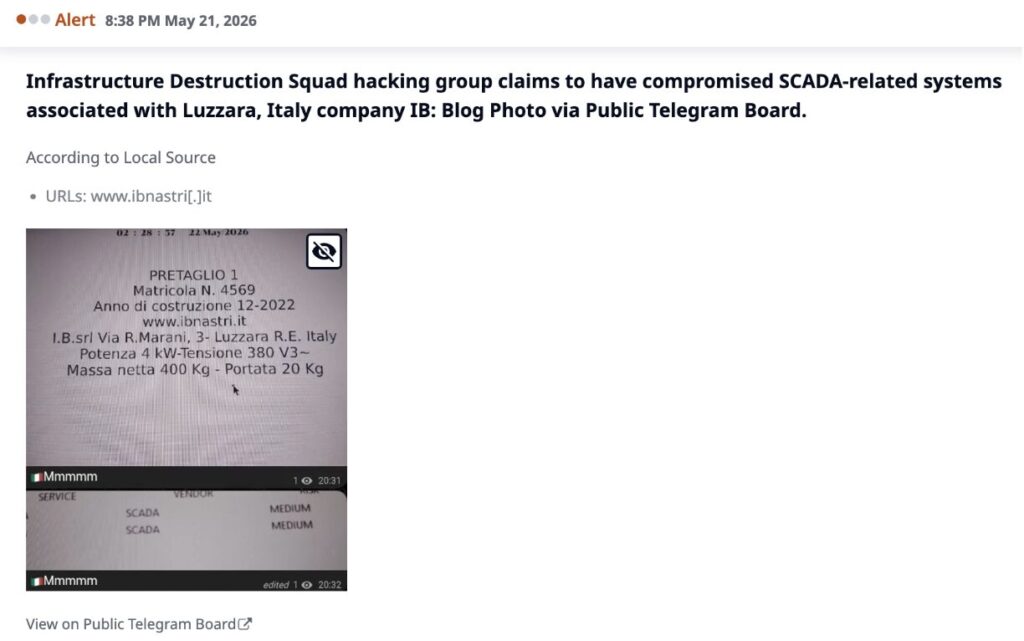
Industrial and SCADA Infrastructure Sabotage Campaign: Threat actors targeting industrial operations in Italy executed high-impact network breaches aimed directly at Operational Technology (OT) and Supervisory Control and Data Acquisition (SCADA) systems.
Most notably, the Infrastructure Destruction Squad gained unauthorized access to the internal network of New Ecology System S.r.l., infiltrating their SCADA-based industrial control systems. The intrusion resulted in a total shutdown of servers and operational infrastructure at a municipal solid waste treatment plant in Potenza, disabling all real-time monitoring and control systems and completely halting waste processing operations. In parallel, the Morningstar hacking group expanded on this industrial targeting vector, actively claiming successful exploitation and remote access over unspecified Italian industrial control platforms, alongside connected commercial electrical, facility security, and localized heating systems, highlighting a growing threat to physical municipal and industrial utility controls.
Priority Risk Indicators
- Coordinated Air Cargo and Transit Blockades: Staging patterns of illicit vehicle parking at critical logistical intersections or synchronized breaches of security barriers near passenger processing gates.
- Infrastructure Copper and Cable Theft: Recurrent trespass patterns and physical tampering within high-speed rail line tunnels, specifically targeting signaling power lines during low-visibility windows.
- Arterial Highway & Corridor Gridlock: High-density vehicle collisions, persistent vehicle stalls, and long-term lane capacity restrictions surrounding primary transit hubs, creating localized multi-lane blockages and route detours across municipal road networks.
About the Risk Report
Dataminr is the global leader in AI-powered real-time intelligence, delivering the earliest actionable indicators of breaking events, emerging threats, and unexpected risks by leveraging 60+ specialized large language models (LLMs) and over 13 years of trusted historical data to instantly synthesize information from 1.2M+ publicly available data sources in 150+ languages across text, image, audio, video, and sensor data.
This report is an AI-powered retrospective risk assessment using data surfaced by the platform. The information illustrates the types of hyperlocal events and risks Dataminr detects in real-time. It is not a representation of Dataminr’s real-time intelligence products.

Turn Public Data into Action
Gain critical context and increase decision-making speed with AI-Powered Real-Time, Event, Threat & Risk Intelligence.
REQUEST A DEMO