About the State Transportation Agency
- Oversees rail operations for the entire state
- Liaises with passenger and freight rail companies
- Responsible for ensuring public safety, rail operation continuity, and executive official awareness
Executive Summary
- Communication gaps with railroad companies and a desire for better real-time awareness left a state transportation agency seeking improved response to rail incidents.
- Dataminr First Alert’s AI-powered real-time event and risk detection now discovers freight rail incidents well in advance of official railroad notification or media coverage.
- In a major rural derailment, the agency received alerts and dispatched personnel over an hour before the carrier officially confirmed the event, allowing for proactive communication with state officials and a strong public response.
- Dataminr helped the state agency shift from a reactive observer to an informed leader, improving operational safety and relationships with rail partners.
For a state transportation agency responsible for rail operations and safety, the gap between when an incident occurs and when official notification arrives can stretch from minutes to hours. In the world of interstate commerce—where federal regulation often preempts state oversight and reporting timelines can be measured in weeks—that gap can leave agency officials searching for information when the state executives call, cameras arrive, and the public demands answers.
That changed when the agency adopted Dataminr First Alert. Today, the agency’s rail operations team uses the solution to access public information sources like police scanner feeds, social media, and news sources in real time—giving them situational awareness that often outpaces even the railroad companies themselves.
The Challenge: A Communication Gap Built into the System
Rail operations in any state exist within a complex regulatory environment. Passenger carriers like commuter rail operators typically work under detailed operating agreements that spell out notification requirements. When something goes wrong on the passenger rail side, the state agency hears about it.
Intercity railroads often are a different story. Operating largely under federal jurisdiction, they may not be required to share incident reports with state agencies. This can often result in communication gaps between the state agency and freight rail operators.
When an incident like a derailment occurs, a railroad’s operations team is simultaneously managing crew safety, hazardous materials assessments, emergency response coordination, and a flood of incoming communications from their own organization. Notifying a state transportation agency may not be at the top of that list. As one rail operations manager put it, “when you get the call, you grab your keys and your boots, and you head that way.”
For the agency, this resulted in a pattern of benign neglect. Minor incidents—even those technically reportable to federal authorities—went unshared with the state. The agency often lacked a reliable way to know what was happening on freight lines within its own borders until the information was already public.
Adopting Dataminr First Alert: A New Layer of Situational Awareness
The agency came to Dataminr to help them fill this gap.
Relevant and contextual alerts
The rail operations team started by configuring a series of alert lists tailored to their specific risk detection needs. One operations leader created a list that casts a deliberately wide net, capturing any mention of derailments or incidents involving hazardous materials anywhere in the country. The rationale: a small number of irrelevant notifications from distant states is an acceptable trade-off for the assurance that nothing significant will be missed.
Additional lists focus on incidents directly affecting the agency’s operational territory—vehicles stuck on or driving along tracks, trespassing incidents, and activity along major rail corridors.
Real-time localized information
The platform’s ability to scan and parse police scanner radio feeds emerged quickly as its most valuable feature for the rail operations team. Scanners capture first responder communications in real time—often the earliest structured signal that something has gone wrong in a specific location.
Supporting safe public gatherings
Beyond emergency incidents, the team uses First Alert to uncover public events that could affect rail operations. Large civic gatherings, such as parades or sporting events, can significantly alter rail passenger volumes and, in some cases, create safety considerations near rail infrastructure. Notifications about events in real time allows the agency to coordinate with railway police and ensure that protected public activities remain safe and operationally manageable.
Early warning function
First Alert also supports a broader early-warning function for the team, allowing them to provide detailed information about emerging events to the state commissioner and other senior leadership. Disruptions in adjacent states—even those originating hundreds of miles away—can ripple outward and affect rail service in the state within hours.
When a major freight carrier experienced a prolonged IT outage that snarled rail traffic in the region, the agency was able to brief its rail administrator several hours before the impact arrived. Leadership could explain the root cause of the rail delays clearly and accurately, protecting relationships with partner carriers and managing public expectations.
Incident Deep Dive: A Rural Freight Rail Derailment
The clearest demonstration of Dataminr First Alert’s value came when a freight train derailed in a rural part of the state, sending multiple cars—including tank cars carrying hazardous materials—into a waterway.
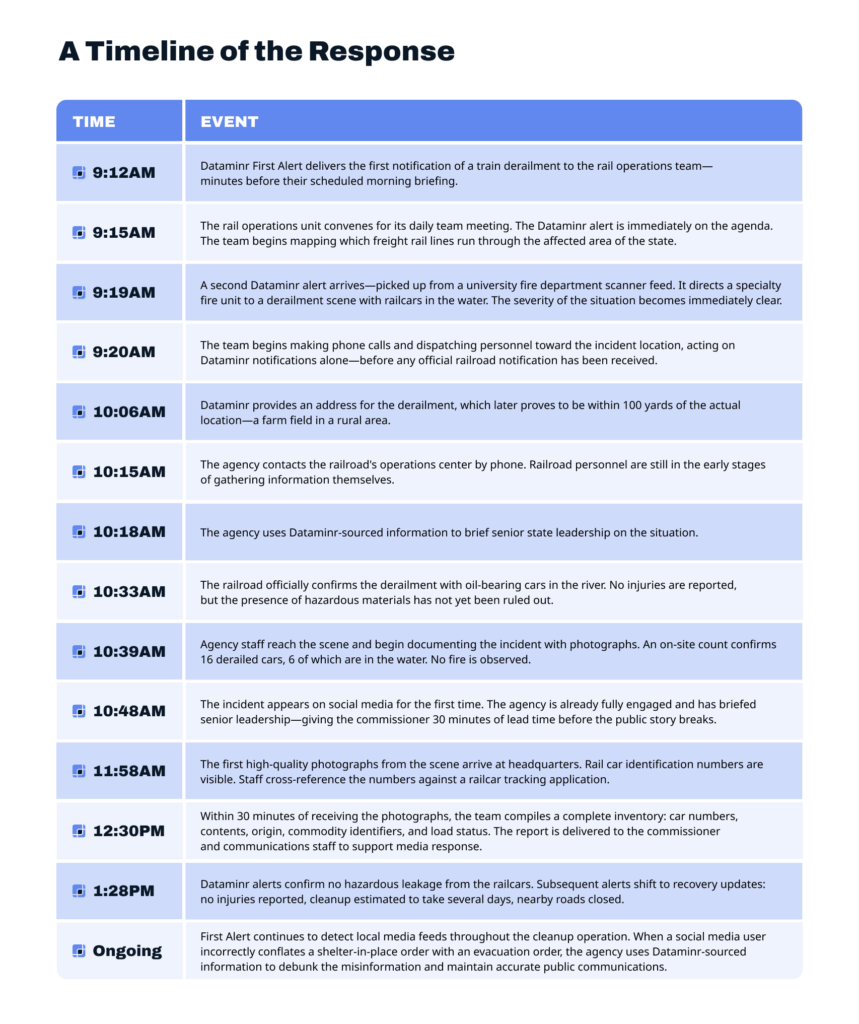
What followed over the next several hours illustrated exactly what early, accurate situational awareness makes possible—and what its absence would have cost.
What the Early Warning Made Possible
The timeline tells only part of the story. What the early warning actually enabled was a cascade of informed decisions that would have been impossible—or significantly delayed—without it.
Swift and appropriate response
When the first alert arrived at 9:12 AM, it was generic: a train derailment, no specific location. But it was enough to start the process of verification. By the time the second alert arrived seven minutes later—with scanner audio from a university fire department directing a specialty unit to a scene with cars in the water—the team knew this was a major incident and acted accordingly.
On-scene state agency leadership
Dispatching personnel to the scene immediately, before the railroad had even confirmed the event to the state, proved to be consequential in ways beyond the initial response. When television news crews arrived, they reported that the state transportation agency already had a presence at the scene—alongside local first responders and other state officials. That visible engagement shaped early media coverage and communicated to the public that the state government was actively managing the situation.
“The jump we got on the situation strictly because of First Alert is irreplaceable. Waiting for that information would have meant 30-60 minutes without someone on site representing the State DOT.” – State Department of Transportation Representative.
Effective emergency management and communication
The photographs that arrived from the scene shortly before noon enabled something that would otherwise have taken far longer: a systematic inventory of every derailed car. By cross-referencing car numbers with a railroad tracking application, the team was able to identify the contents of each car, its origin and destination, its hazardous material classification, and whether it was loaded or empty. Within 30 minutes of receiving the photos, a complete report was in the hands of the commissioner and communications staff—ready to support accurate, detailed responses to media inquiries.
“If we had not had First Alert when the phone started to ring and the texts came in from the Governor and Commissioner’s offices, we would have been a day late and a dollar short,” said a State Department of Transportation Representative.
Clear and correct information sharing
Dataminr also played a role in managing the information environment after the initial response. When a social media post confused a shelter-in-place order with an evacuation order, the team was able to use First Alert’s information to verify that no evacuation had been ordered and correct the misinformation before it spread further. In high-stakes situations, that kind of rapid fact-checking is not a minor convenience—it is a core function of effective emergency communications.
Outcomes: Faster Response, Better Relationships, Stronger Communications
The benefits of Dataminr First Alert have been felt across multiple dimensions of the agency’s operations.
The most immediate impact has been on response times. The agency now routinely learns about freight rail incidents—including relatively minor ones that would previously never have been shared—before official notification arrives. This is not only operationally valuable; it has changed the dynamic with freight carriers. When agency staff call a railroad already knowing the facts of a situation, it signals a level of awareness and competence that commands attention.
At the executive level, Dataminr has enabled a shift from reactive to proactive communication. Senior officials no longer learn about significant incidents from reporters or political staff—they are briefed in advance, with accurate information, and are positioned to lead the public narrative rather than respond to it.
During extended incidents, First Alert has also served as a coordination tool within the agency. During the multi-day recovery operation following the derailment, the rail operations team used alerts to maintain situational awareness at the scene, track weather developments along the recovery corridor, and share relevant updates with field personnel rotating in and out of the site.

The Total Economic Impact™ of Dataminr First Alert
Public-sector organizations face increasing risks. To help, Forrester Consulting analyzed Dataminr First Alert and found it:
- Accelerates first response
- Enhances operational resilience
- Delivers measurable financial benefits
This report offers a framework for decision-makers to evaluate how Dataminr First Alert can provide transformational value, enabling proactive responses and safeguarding critical missions.
Read the Report