Executive Summary
- Defense organizations face challenges in achieving Information and Decision Advantage due to overwhelming data volume, blind spots in remote areas, and slow detection speeds.
- Analysts are overwhelmed by unmanageable workflows and hindered by interoperability challenges, risking missed threats and operational paralysis.
- AI-powered technologies offer solutions by processing big data, reducing noise, and providing actionable insights at scale.
With multi-domain operations now including elements of conventional, asymmetric and hybrid warfare, being able to detect and process these broad and dynamic threats is becoming more challenging.
For defense organizations across North America, EMEA, and APAC, the strategic goal has shifted. Achieving success now depends on Information Advantage, defined by the UK Ministry of Defence as “the credible advantage gained through the continuous, adaptive, decisive and resilient employment of information and information systems.” Similarly, the U.S. Air Force describes Decision Advantage as “the product of situational understanding, the ability to assure and exchange information, make and communicate decisions by maintaining advantages in all domains.”
Achieving this advantage, however, is becoming increasingly difficult. The data-rich digital environment is expanding exponentially, creating a paradox for analysts: there is simultaneously too much information to process and not enough actionable information obtained. This gap between turning raw data into Information and Decision Advantage poses significant risks to all defense-focused missions.
The Data Deluge: Drowning in Information
The most immediate challenge is volume. We have moved past the age of information scarcity into an era of overwhelming abundance.
For human analysts, this scale is unmanageable. The sheer velocity of data creation outpaces human cognitive capacity. To put this into perspective, consider the daily intake of a global AI platform like Dataminr, which processes over 43 terabytes of public data every 24 hours. To process that volume manually, a defense organization would need approximately 3 million analysts working around the clock 24/7.
This overwhelming volume of data and alerts creates operational paralysis. When analysts are buried under mountains of raw data, they spend their valuable time sorting and filtering, rather than analyzing and assessing. The risk here is not just burnout; it is the high probability that a critical threat indicator will be missed simply because the team doesn’t have the time or ability to detect it.
The Information Void: Blind Spots in Remote Areas
While some regions suffer from data saturation, others suffer from silence. Defense organisations are often tasked with using finite resources to obtain information in denied, degraded, contested and/or congested environments. As such, they cannot offer persistent or ubiquitous utility across the globe.
This creates information collection gaps, both in time and space, resulting in dangerous blind spots. Events occurring in austere or less ‘connected’ environments can go unnoticed until they escalate into major crises.
Relying on traditional news aggregators to fill these gaps is often insufficient. Conventional information providers may miss relevant activity in these regions. Without a mechanism to surface insights from these “dark” areas, commanders are forced to make decisions with incomplete pictures of the operating environment.
The Latency Trap: Speed of Detection
Timely and accurate decision-making is a key contributor to mission success. Information is perishable; event, threat or risk intelligence that arrives an hour late is often history, not insight, and presents significant risk to life, mission, and reputation
Adversaries are speeding up their operations, leveraging commercial technologies to plan, coordinate, and conduct their activities at pace. Defense organizations struggle to match this tempo when relying on manual verification or aggregated news cycles. The lag time between an event occurring and a commander knowing about it—the “flash-to-bang” time—is often too long.
Operational tempo demands real-time situational awareness. Tools that offer speed advantages, detecting events roughly five times faster than aggregated news, provide “decision space.” This extra time allows leaders to orient, plan, and act in the most effective manner, before an adversary can react. Without this speed, organizations are perpetually reactive, surrendering the initiative to the opposition.
The Signal-to-Noise Problem
More data usually means more noise. Defense analysts are tasked with finding needles in global haystacks. The challenge is not just finding the relevant information, but discarding the irrelevant.
Unfiltered data streams increase the cognitive burden on personnel. Without advanced filtering, analysts waste time, effort and resources chasing false positives or irrelevant chatter. This inefficiency slows down the OODA (Observe, Orient, Decide, Act) loop. The goal is relevance—stripping away the static to reveal the clear, actionable signal.
The Interoperability Barrier
To conduct effective operations, defense organizations must operate in joint, combined, or coalition environments. This requires seamless coordination between government, partners, and international allies.
However, information is often siloed. Classified data is difficult to share rapidly, and disparate systems struggle to talk to one another, resulting in a lack of information parity between organizations, restricting operational coherence. The solution lies in unclassified, shareable data that can move instantly across borders, systems and bureaucracies.
Bridging the Gap
The quest for Information and Decision Advantage is fraught with obstacles. Defense organizations are caught between data overload and information gaps. But solutions exist where organizations no longer have to choose.
To maintain an edge, organizations must look toward AI-powered technologies that can act as force multipliers—systems that handle the scale of big data, illuminate blind spots, surface unknowns, and deliver relevance at scale. Only by solving these fundamental challenges can defense leaders ensure they are making the most informed decisions when it matters most.
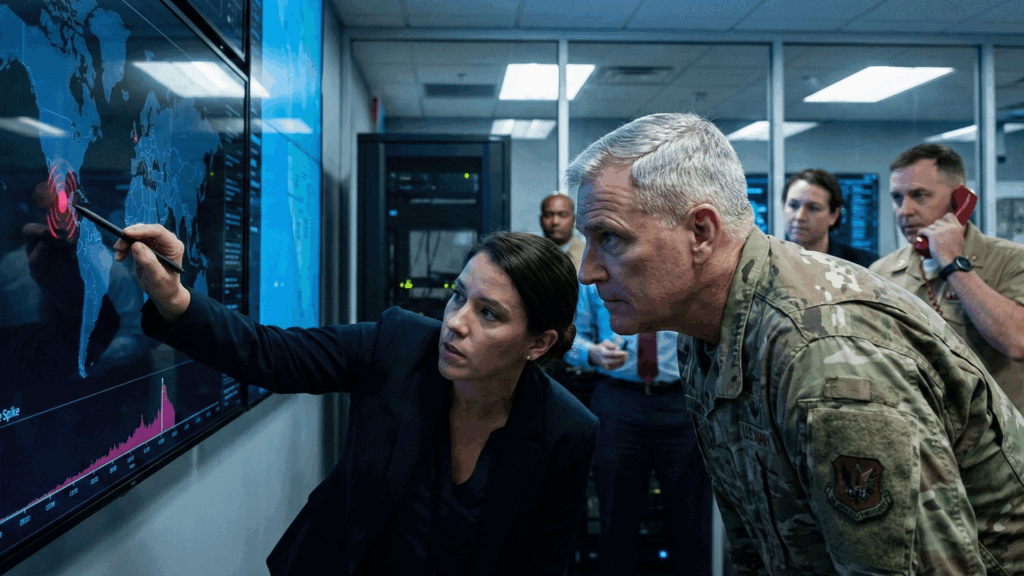
Delivering Information and Decision Advantage in the Defense Sector
Dataminr’s AI platform helps defense organizations gain Information and Decision Advantage by delivering mission critical real-time, multi-domain information at speed and scale.
Learn How